Known-person recognition
HOG face detection locates a face, then the local face_recognition pipeline compares its encoding with the cached entries in known_faces_cache.pkl. A matched name can replace the generic word “person” in an alert.
ENGINEERING • AI • ASSISTIVE TECHNOLOGY
A Raspberry Pi 5 wearable assistive computing system that detects nearby obstructions and speaks alerts to the wearer, while its perception, decisions, speech, and device controls run locally without Wi-Fi or cloud services.
OVERVIEW
Whispering Hat is a wearable assistive AI system designed to help blind and visually impaired people move through the world with more awareness and confidence.
Instead of describing everything in view, the hat focuses on information that can help in the moment: an obstacle in the walking path, something getting closer, or a person the wearer may recognize. It turns those observations into short spoken alerts, helping the wearer notice important changes without being overwhelmed by constant narration.
Image recognition can also help the wearer know who they are interacting with by identifying familiar people locally. Facial-expression recognition adds another layer of social context by describing visible cues such as a smile, surprise, or concern, helping the wearer take part in conversations and understand the emotional tone of an interaction. These are estimates of what is visible, not claims about what someone is truly feeling.
By bringing this awareness directly to the wearer through local audio, the project can support more independent movement and make nearby surroundings easier to understand. Voice controls also let the wearer pause or resume detection when they choose.
DEMONSTRATION
Watch the wearable system detect nearby obstructions and communicate relevant alerts to the wearer.
THE CHALLENGE
A normal object detector can identify dozens of things in a camera frame, but announcing every detection would overwhelm a blind user. Whispering Hat therefore evaluates context before deciding whether a spoken alert is useful.
Another important direction for the project is reading diagrams. A future mode could describe the layout of a chart, map, science figure, or classroom diagram in words, helping a visually impaired student access visual information without needing someone beside them.
PROCESSING PIPELINE
CORE ARCHITECTURE
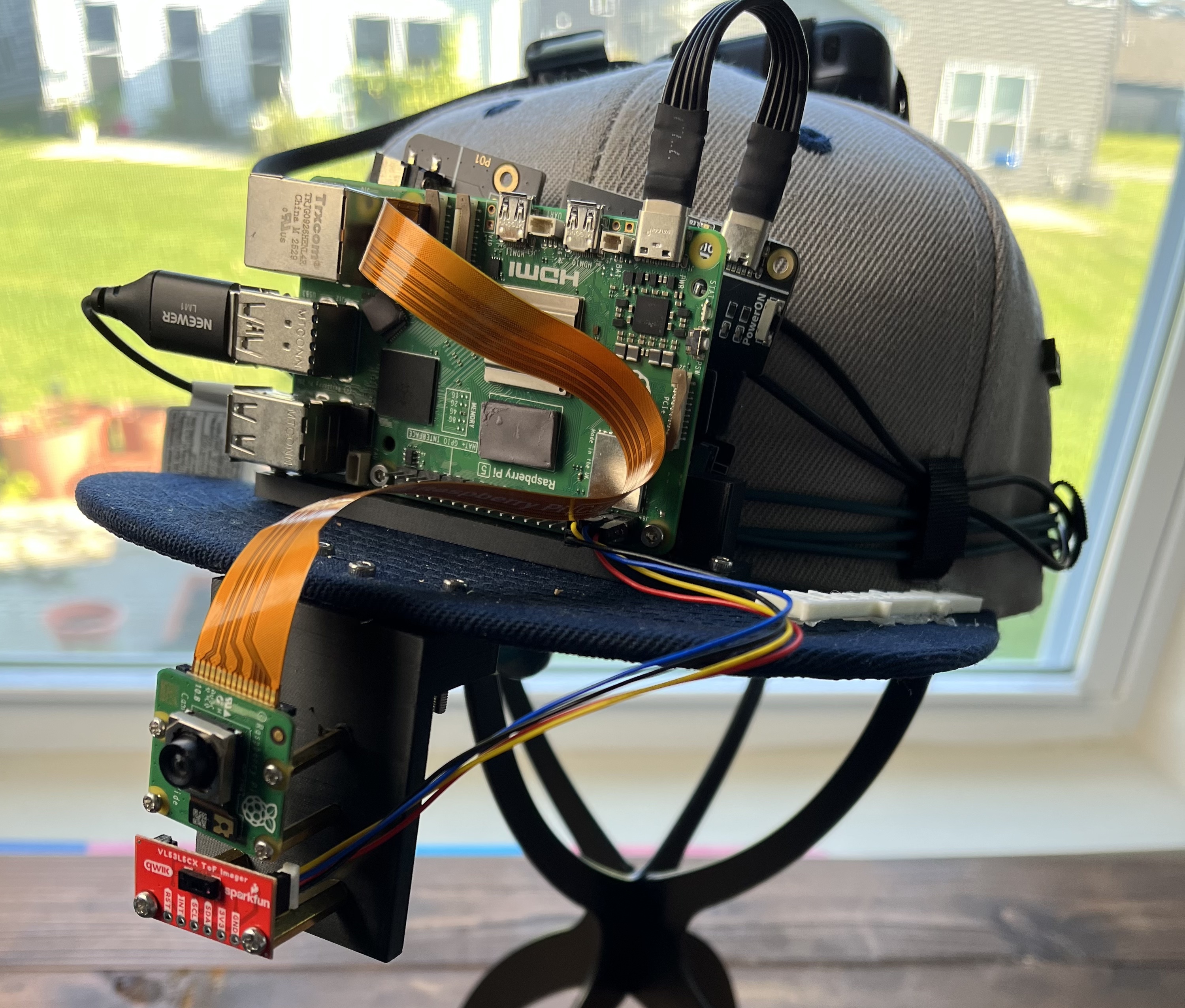
All awareness and decision-making runs inside the Raspberry Pi 5 local processing boundary. Camera capture, depth sensing, inference, risk logic, speech, and voice control are coordinated as separate workloads rather than one blocking loop.
OBJECT AWARENESS
Whispering Hat does not simply speak the name of every object YOLO detects. Its rules classify situations as SAFE / PASSIVE, NOTICE, CAUTION, or STOP, then modify those risks using the walking corridor and the object's category.
The risk score is built from engineered rules and sensor information, not copied from YOLO confidence. A trapezoidal walking corridor makes objects in the path more important than objects at the side, while camera/depth fusion adds real distance and time-to-collision signals. Short tracking and alert histories smooth approach signals and prevent the same warning from being repeated on every frame.
HUMAN AWARENESS
HOG face detection locates a face, then the local face_recognition pipeline compares its encoding with the cached entries in known_faces_cache.pkl. A matched name can replace the generic word “person” in an alert.
The bundled FER2013-style TensorFlow Lite model estimates angry, disgust, fear, happy, sad, surprise, or neutral from a cropped face. Readings are smoothed; this is visible-expression estimation, not knowledge of a person's internal emotion.
COMPLETELY OFFLINE
Whispering Hat is designed so its core awareness system does not depend on Wi-Fi or cloud services.
YOLO11n, ByteTrack, VL53L5CX processing, risk logic, HOG face detection, cached face matching, FER2013 TFLite inference, Vosk recognition, and eSpeak speech output operate locally on the Raspberry Pi. Once the models and software are installed, no cloud inference is required.
No Wi-Fi required for core operation.
Vosk accepts only “detection on” and “detection off.” Turning detection off pauses awareness processing while the camera continues running, making voice control deliberately simple rather than a general assistant.
TECHNICAL STACK
Raspberry Pi 5
Raspberry Pi OS Trixie / Linux
Camera Module 3 Wide with Picamera2 + libcamera
YOLO11n + ByteTrack
VL53L5CX 8x8 Time-of-Flight with SparkFun Qwiic / I2C
HOG face detection, face_recognition encodings, and local pickle cache
FER2013 TFLite / LiteRT-compatible inference
Vosk + SpeechRecognition + PyAudio; eSpeak and PipeWire / pw-play
Python, OpenCV, NumPy, and CSV event logging
ENGINEERING FOCUS
The difficult part was not running one AI model. It was getting everything to work together quickly enough to be useful. The camera may produce frames faster than YOLO can process them, while the depth sensor produces a separate 8x8 coordinate system that must be aligned with the camera view.
Background workers, latest-frame capture, scheduled inference, tracking and depth memory, face memory, expression smoothing, alert memory, priority queues, cooldowns, and risk escalation keep one slow operation from freezing the wearable system. Face recognition, emotion inference, voice recognition, and speech therefore run on their own schedules or workers.
REFLECTION
The hardest part of Whispering Hat was not getting YOLO, a distance sensor, or a face model to work individually. It was deciding how all of them should work together.