Walk in multiple gaits
Omnix can move forward, backward, and sideways, turn, and switch between tripod, ripple, and wave walking patterns.
ROBOTICS • EMBEDDED SYSTEMS • CAD
An open-source, 3D-printed hexapod robot with 18 servos, multiple walking gaits, IMU sensing, and an animated face with live system dashboards.
GitHub repository ↗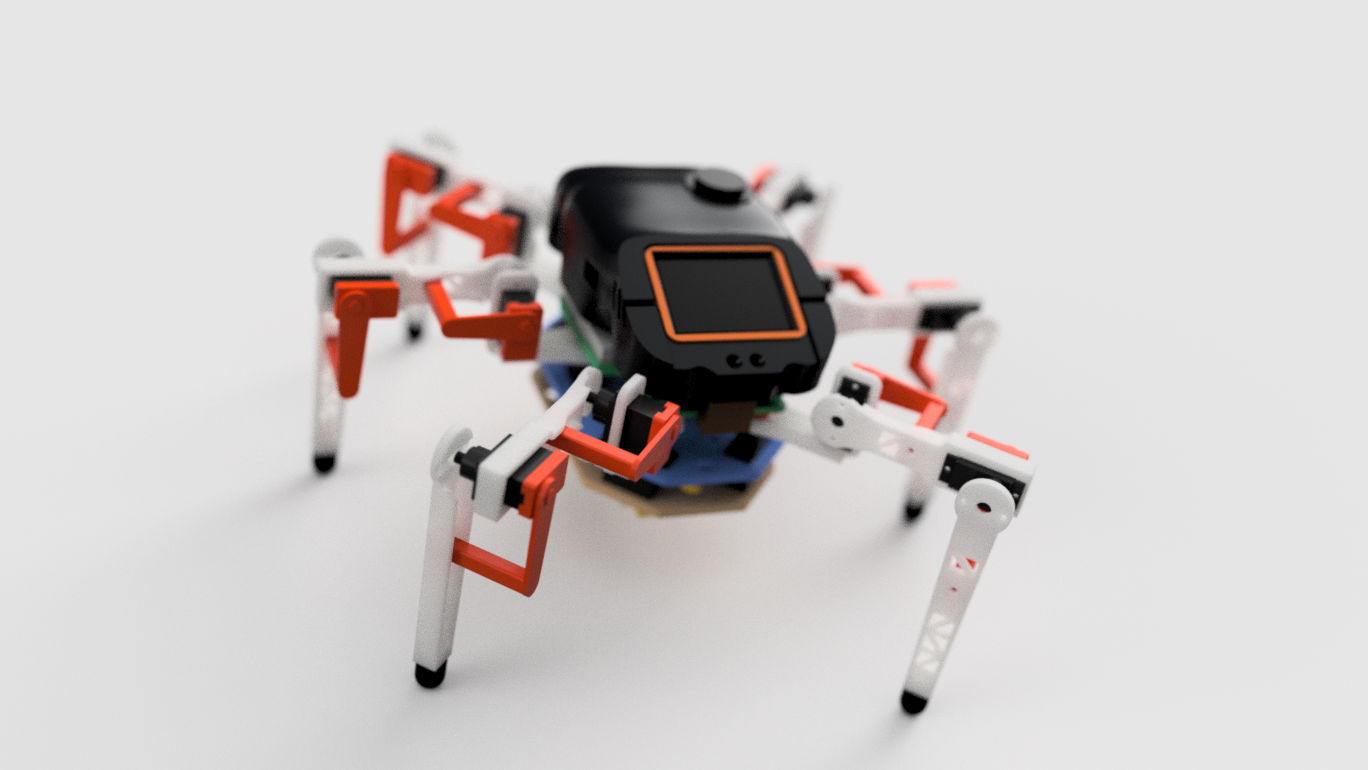
OVERVIEW
Omnix combines mechanical design, embedded control, sensing, and expressive display into one six-legged robot.
The body, legs, head, and feet are 3D-printed. An ESP32 coordinates the robot's motion, settings, and inertial sensing, while a Beetle RP2350 drives a small color display for the animated face and live dashboards.
The repository documents the build from printed parts and wiring through firmware, calibration, troubleshooting, and motion diagnostics.
HIGHLIGHTS
CAPABILITIES
Omnix can move forward, backward, and sideways, turn, and switch between tripod, ripple, and wave walking patterns.
Servo targets control body height, stance width, foot lift, and step timing while joint limits and servo-rate guards protect movement.
The accelerometer and gyro support tilt readings, optional leveling, walking assists, and relative gyro heading during turns.
The display renders face animations, tricks, leg positions, stability information, walking assists, and system status dashboards.
HARDWARE
Omnix is built as a complete electromechanical system rather than just a software demo.
Motion controllerAn ESP32 DevKit / ESP-WROOM-32 handles servo motion, settings, IMU data, Bluetooth, and walking control.
Servo systemEighteen MG90S servos provide three joints on each of the six legs.
Servo driversTwo PCA9685 boards provide the pulse outputs needed to control the robot's joints.
Face controllerA Beetle RP2350 renders the animated face and receives telemetry for live dashboards.
Display and powerA 240 × 320 ST7789 TFT provides the face display, with separate regulated supplies for servos and electronics.
CONTROL
Normal operation is local. Omnix accepts typed commands over USB Serial or classic Bluetooth, and the walking, calibration, display, and diagnostic logic runs on the robot's boards without a cloud service.
MovementCommands include forward, reverse, turning, gait selection, stance adjustments, and body-height changes.
CalibrationServo directions, neutral positions, angle scales, battery readings, and IMU mounting can be calibrated for each robot.
DiagnosticsTiming, gyro status, modeled loads, memory, and system state can be inspected from the command interface.
ENGINEERING
One of the hardest parts of Omnix was separating software, wiring, power, calibration, and mechanical problems that could produce similar symptoms.
TECH STACK
RESOURCES
The repository includes the assembly guide, firmware setup, calibration steps, troubleshooting notes, CAD sources, print meshes, wiring diagrams, and bill of materials.